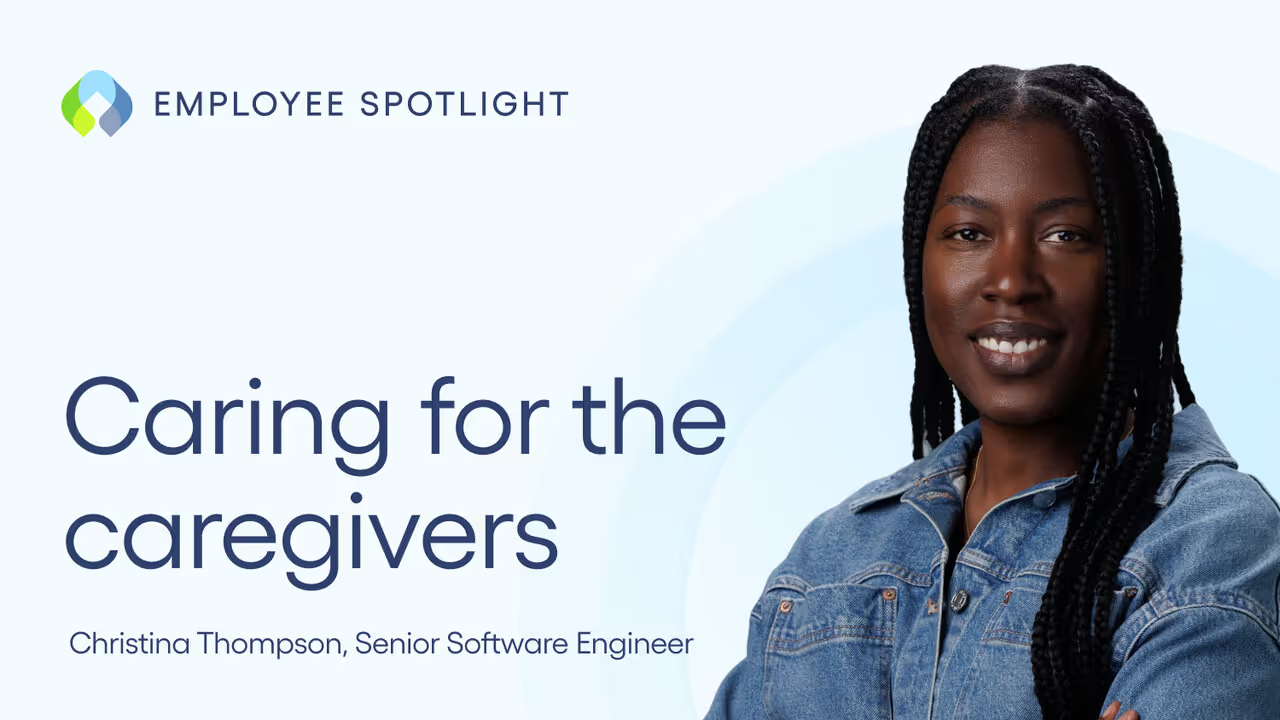
We recently sat down with Christina Thompson to discuss her journey from sports marketing to software engineering, her "right-brain" approach to product development, and why "care" defines Canopy.
What initially drew you to Canopy, and what keeps you motivated in your role today?
I first learned about Canopy through a former colleague who had been here for about six months. At the time, it intrigued me because it was so different from my previous experiences. I had primarily worked at mid-sized B2C startups, and Canopy was a smaller B2B enterprise company. It felt like an interesting new challenge.
What keeps me motivated is that Canopy checks the three core boxes I need to get excited about a company: a mission I can deeply care about, a role as an innovator or disruptor in the space, and a culture of kindness and curiosity. It was different from what I’d done before, which was a little scary, but those boxes made me really excited to join.
What sparks your passion for this industry, and how does your work at Canopy contribute to that?
My connection to healthcare is deeply personal. My sister worked in clinical settings, and I watched her burn out despite being great at her job and passionate about the work. My cousin, with whom I’m close, has also been a nurse for more than eight years and has shared 'horror stories' about settings that you wouldn't expect to be dangerous or concerning.
I started watching the show The Pitt and asked them if it was an accurate depiction. They confirmed that the stress and intensity are indeed part of the job. It really captures the weight resting on charge nurses’ shoulders, the importance of administrators listening to staff, and the critical role of security. That really resonated with me and illuminated how, at Canopy, we are 'caring for the caregivers'. We are protecting the people who are there to care for others.
What is Canopy doing differently in the healthcare tech space?
The differentiator is in our technology. Our three co-founders all have deep, strong technical backgrounds, so there was a very thoughtful investment in the systems that power our platform. It’s not just a quick fix; it’s a robust foundation that we can continue to build on as our product offerings expand.
But it’s also the human element. Our customer-facing teams do an incredible job of sharing meaningful customer feedback, specific use cases, and success stories, ensuring our engineering team is always grounded in reality. Customer stories consistently show that our care and responsiveness are what truly set us apart. That care is felt from the inside out; we are "caring for the caregivers" by protecting the people who care for everyone else.
If you had to describe the company culture at Canopy in one word, what would it be and why?
Care.
The way we care about each other, our customers, and the providers we support is at the core of who we are. We are also intelligent and creative, but it's that foundation of care that takes our work to the next level.
Looking ahead, what are you most excited about for the future of Canopy?
I feel like we’re just getting started. We have solid product-market fit, but there is so much more we can build and expand into. Our technology makes us a market leader now, but I think our continued investment in 'people systems'—maintaining that ingenuity and openness—is what will keep us there.
When you're not working, what does life outside of Canopy look like?
I’m a DJ! I’ve recently started getting back into it and hope to do a little something for our next company offsite.
I’m also a hardcore foodie and coffee enthusiast. I will travel specifically for culinary experiences. Lima, Peru, was incredible! I fell in love with Nikkei cuisine, a fusion of Peruvian and Japanese flavors. I also recently went to Taipei, Taiwan, which was epic; it has a relaxed, accessible culture with an amazing coffee scene. Vietnam is next on my list.
Finally, I’m dedicated to my meditation practice and contemplative studies. I took a year-long sabbatical before joining Canopy to explore this. I believe that developing mindfulness and autonomy over one's own attention is a vital, yet underdeveloped, skill in this modern age of technology.