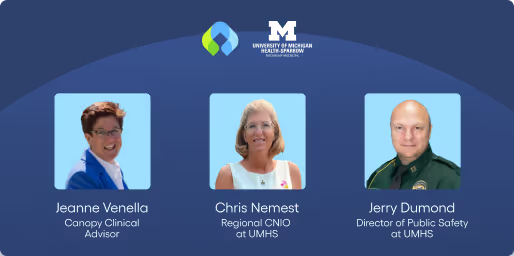
In an era where workplace violence in healthcare is rising, the University of Michigan Health Sparrow embarked on a multi-year journey to enhance staff safety and foster a profound cultural shift. This recap summarizes a compelling webinar featuring Dr. Jeanne Venella, Senior Clinical Advisor, and two key leaders from UMH Sparrow: Chris Nemitz, Regional Chief Nursing Informatics Officer (CINO), and Jerry Dumond, Director of Public Safety.
The conversation highlighted the critical collaboration between nursing and security to successfully implement a modern safety platform and ultimately, make their workforce feel safer.
A Critical Need for Change
The discussion began by underscoring the severe and increasing threat to healthcare workers, especially nurses.
- Despite nursing being voted the most trusted profession for the 21st year in a row, nurses are four to five times more likely to be injured at work than police officers or sheriffs.
- Violence against healthcare employees has dramatically increased since the pandemic.
- 2023 statistics from Press Ganey estimate that two nurses per hour are injured, assaulted, or verbally abused in the U.S. This equates to 57 nurses every 24 hours.
- Verbal abuse is notoriously underreported, with an estimated 80% going unreported because staff believe "it's just part of their job".
These sobering statistics established the necessity for a creative, nimble, and modern solution.
Overcoming Barriers Through Cross-Cultural Collaboration
Jerry and Chris recognized the problem years ago (in 2016), acknowledging that while healthcare is a "safe haven" for patients, internal challenges persist. Their search for a rapid-response solution started, especially given their management of two large facilities, several rural access hospitals, and 130 care sites, led them to realize that the technology at the time "really didn't exist" to meet their needs.
The top barriers to implementing a solution mirrored concerns raised by the webinar's attendees: budget (75% of poll respondents) and administrative buy-in.
A significant challenge was the organizational culture gap related to new technology.
Chris Nemitz stated, "They [staff] recognized that bad things were happening to them... but they really didn't buy into some of the technologies that were out there. There was resistance, you know, change is hard in an organization... The biggest barrier we had with our culture was that they didn't want to wear anything that perhaps would track them."
Chris, with the nursing and IT lens, and Jerry, with the security perspective, worked together to find a solution that addressed these concerns, specifically, a sleek, individually assigned, wearable, non-tracking device with a multi-year battery life.
Vendor Selection and the Power of Trust
The team embarked on a lengthy vendor selection process, prioritizing a partner who understood their concerns rather than just pushing a product.
UMH Sparrow’s comprehensive plan, which included aligning with Joint Commission requirements, helped secure the crucial financial backing: nursing pushed the initiative to the administration, making it known this was their top priority for support.
A Culture Shift in Action: The Power of Adoption
The technology's adoption was immediate and widely embraced.
Of the first 1,400 badges deployed, over 95% of staff voluntarily accepted the badge (it was not required). Within an hour and a half of deployment, the device was used in an incident, which helped "light a fire" and drove further adoption. Canopy just worked. The system not only alerted Public Safety but also activated proximate alerts to nearby co-workers. One emergency department nurse recounted having 14 proximate alert peers assisting him during a physical altercation, even before security arrived, highlighting the power of immediate community response.The "loudest" initial non-adopters have since requested the badge after seeing the value and quick response times.
Measuring Success and a Brighter Future
Success was and will continue to be measured by several key outcomes:
- Team members feeling safe (measured via pre- and post-surveys).
- Retention (as safety is tied to burnout and turnover).
- Time to rescue, which is now precisely measured from the moment the button is pressed.
The Joint Commission recognized the successful program during a recent survey,
Jerry Dumond stated, "Anytime the Joint Commission is at your facility, and then they tell you you're an industry best practice... that's the words you want to hear out the door."
For Jerry, the connected system offers a "peace of mind" for all staff, especially the home care and hospice teams who operate in unfamiliar and potentially vulnerable settings.
Jerry Dumond stated, "We're going to continue through an HR process of watching the burnout and the violence, but we're also tracking injuries... if [staff] feel safer at work, I think I am doing my job."
Chris is excited that the success of this wearable device is a "huge win" that breaks down previous cultural barriers, potentially opening the door to future efficiencies through other innovative technologies like AI.
See the full webinar here.