When R.L. Hughes stepped into the role of Director of Safety, Security, and Sustainability at Beebe Healthcare, a nonprofit community health system serving coastal Delaware, he inherited a familiar challenge: workplace violence was increasing, and staff didn't feel safe. He knew he needed to address the issue head-on, so he began the process of making the case for an investment that would not only protect staff, but also help prevent violence altogether.
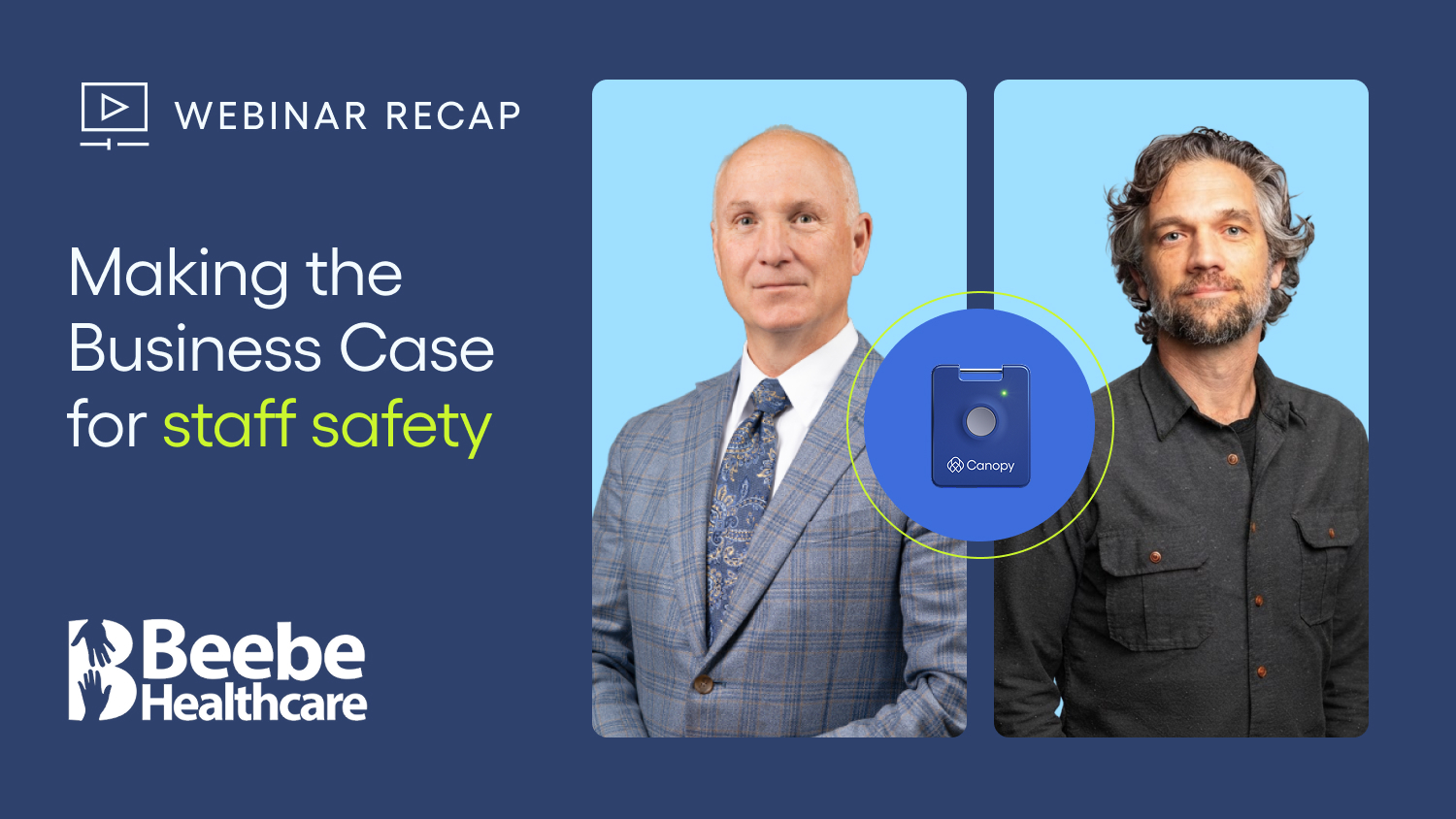
Hughes recently joined Justin Green, VP of Strategy at Canopy, for a webinar on his approach to building consensus, finding funding, and making a safety investment stick.
Key takeaways
- Building organizational consensus matters as much as choosing the right technology. Workplace violence is not a security problem or a nursing problem. It becomes solvable when the right coalition of stakeholders owns it together.
- Every stakeholder needs a different conversation. Nursing wants faster response. Finance wants ROI. IT wants minimal lift. The case for safety is strongest when it speaks to each audience in their own language.
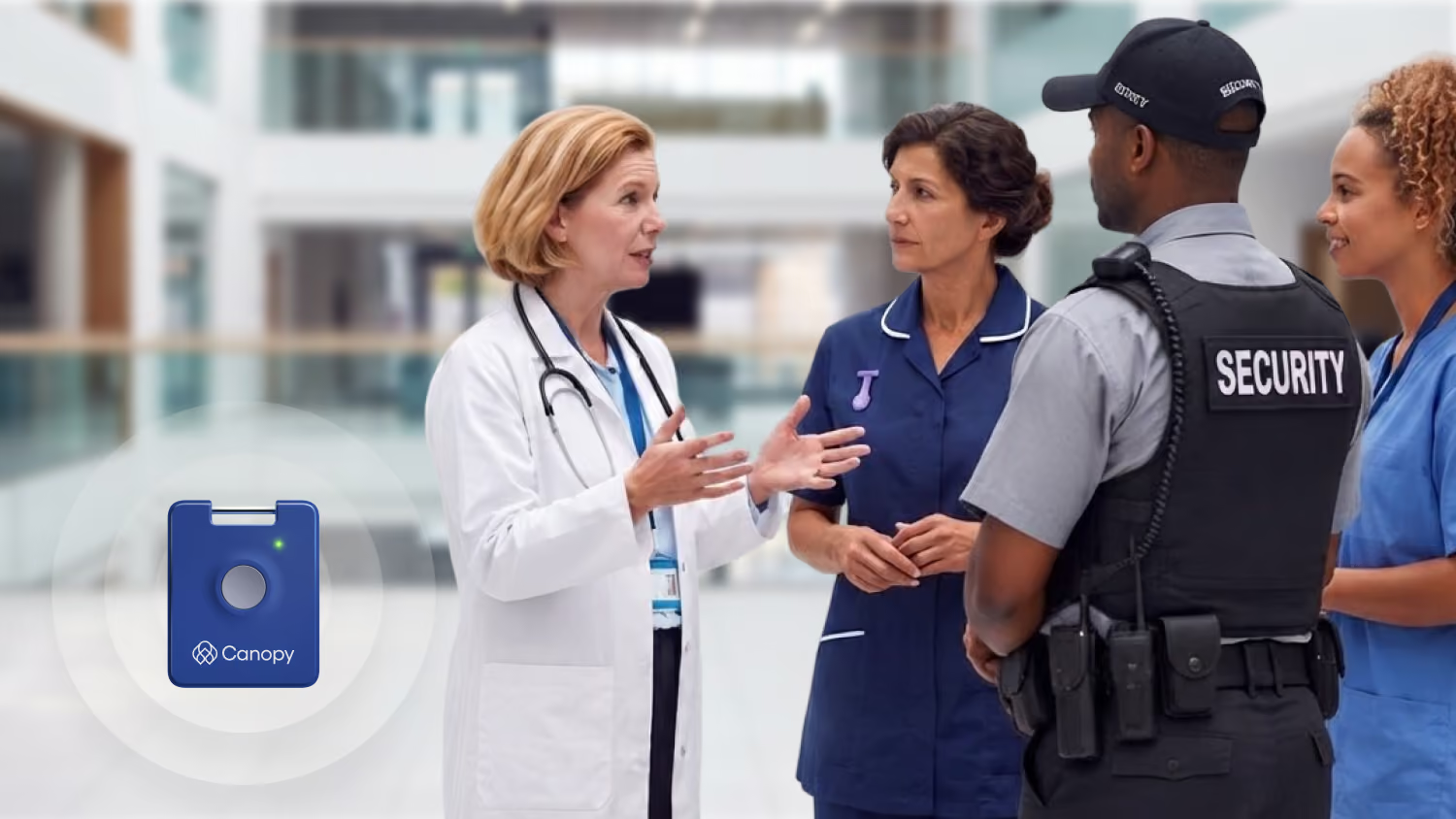
- The Canopy Button links staff to their colleagues, their security team, and their de-escalation training at the moment it matters most. It’s a connector to the overall strategy of building a culture of safety.
Start With the Problem, Not the Solution
Hughes's first attempt to address staff safety at Beebe didn't go as planned. He came to leadership with a long list of requests, including additional security staff, AI detection technology, expanded training programs, and more. The ask was too big, causing it to stall.
"I overwhelmed our executives with too much data, too many requests, too many asks," Hughes said. "And quite frankly, the reason for that was I didn't know what I was asking for."
It quickly became clear that before making a case for any investment, he needed to clarify the problem so he could focus and direct the conversation. For Hughes, that meant building a coalition, pulling in clinical, operations, executive, and security stakeholders, and shifting the question from "what happened in the past?" to "where is the risk?"
Instead of pointing to incident history, the team started identifying the conditions that created risk, such as behavioral health presentations, substance use, dementia and delirium patients in an aging community, and the geographic realities of a coastal healthcare system that sees significant seasonal population swings.
Why a Wearable Duress Button
With a clearer picture of the problem and a coalition behind him, Hughes narrowed his focus. Rather than trying to solve everything at once, he looked for a single investment that could do the most to connect people and expand Beebe's security footprint without requiring a full security staffing overhaul.
He found the answer in wearable duress technology. But what convinced him wasn't the product itself; it was a field visit to another health system already using it.
"Comments like, 'I wouldn't work here if I didn't have that. I feel so much safer,'" Hughes recalled. "I think it actually makes you safer, but the feeling part is very important."
That feeling of safety became central to how Hughes made the case internally. As Green put it during the webinar: "There's good data to show that when people feel safer, they stay. They don't quit. When they feel safer, they provide higher quality care."
Tailoring the Message to Every Stakeholder
One of the most practical frameworks Hughes shared is how he approached each stakeholder group differently, starting every conversation by identifying what mattered most to them.
For nursing leadership, the question was straightforward: do you want your nurses to be safer and to have someone respond faster when they need help? The answer was always yes.
For executive and finance leadership, he introduced the concept of return on value alongside return on investment.
"Yes, there's an investment," he said. "But the return on value is that we as an organization value each other." He connected the safety investment directly to employee engagement scores that had been moving in the wrong direction, and to the cost of turnover and workers' compensation claims that came with an unsafe work environment.
For IT, the concern was integration and lift. How does this work with existing infrastructure? What does implementation actually require? For operations, it was about workflow: how does this fit into the day-to-day without adding burden?
"Once we get folks to understand that we can identify their individual or departmental concerns, but then show them how that impacts the entire organization, it creates that whole culture of safety," Hughes said. "We are all in this together."
Workplace violence had been siloed in how it was approached. Security had been treating it as a security problem. Nursing had been treating it as a nursing problem. When the coalition came together and reframed it as a culture initiative with shared ownership, there was more buy-in to solve the issue together.
Use Data to Build and Sustain the Case
Data was also central to how Hughes built and sustained the case internally. Daily shift logs, a custom workplace violence report tracking incident severity, patient demographics and underlying conditions, and the Epic Violence Assessment Tool all feed into a picture that lets the team anticipate risk rather than just react to it.
"We can come back and say, at 10 p.m. on a certain day of the week, this is highly likely what we're going to be seeing," he said. "And it's very good when you can come back to the data and say, Mr. President, here's what our data's showing us."
That data discipline also drives the ongoing business case. Hughes tracks the metrics that matter most to each stakeholder: response times and security footprint for the security team, turnover and engagement for HR and executives, workers' compensation and lost days for finance. The goal is to show impact over time, not just justify the initial investment.
Funding a Duress Solution
Funding the investment required the same coalition-building approach. After a significant incident, Beebe's CEO committed to finding the money. Working with the organization's medical foundation, Hughes and his team made the case directly to donors, presenting as a unified team rather than a security department asking for security resources.
"We came as a team instead of R.L., the security guy, coming in asking for something for security," he said. "This is for Beebe."
The foundation funded the initial deployment. Looking ahead, Hughes is exploring grant funding through FEMA's Nonprofit Security Grant Program, a per-employee cost model similar to how Beebe funds IT infrastructure, and ongoing fundraising through the medical foundation.
The Canopy Button as a Connector
One thing Hughes made clear is that Canopy's wearable duress button isn't the strategy; it's a connector that links together every other element of that strategy.
"That button connects you to your security team, to your colleagues through proximate notifications, to the de-escalation training you've received, and to action and intervention," he said. "Make no mistake, this is not our strategy. It's a part of that, and it serves a very large purpose connecting all of the dots."
In practice, that connection has already made a difference. When a group of staff at one of Beebe's satellite locations tested the button for the first time, the response was immediate.
"You could literally hear folks cheering in the background," Hughes said. "'Hey, it worked. I have it over here.' That's a big piece for us."
The FOMO is real too. With buttons currently deployed on higher-risk units and in the ED, Hughes is fielding requests from across the organization. "I've got folks wanting the button because they want that tangible piece, something that helps them feel safer," he said.
Beebe plans to expand to all 44 satellite locations, including sites with no dedicated security presence, where Proximate Notifications mean colleagues become the first line of response.
The Takeaway for Champions
The path Hughes took at Beebe offers a practical playbook for any safety leader trying to move a similar investment through their organization:
- Understand the problem before proposing the solution. A focused, well-researched ask is more effective than a comprehensive wish list.
- Build a coalition across silos. Workplace violence is not a security problem or a nursing problem. It is an organizational problem, and the case for investment is stronger when it is made by a team.
- Tailor the message to each stakeholder. Every leader has a different lens. Speak to theirs.
- Lead with feeling, support with data. The emotional case and the financial case are both necessary. Neither alone is sufficient.
- Get creative about funding. Foundation dollars, grants, per-employee cost models, and departmental cost-sharing are all options worth exploring.
- Show the return. The ongoing investment depends on demonstrating impact. Build the metrics before you need them.
As Hughes put it in closing: "Don't look for perfection. Our goal is progress. We want to keep moving forward, making progress toward a safer environment for everyone."
Watch the Webinar
Watch a full replay of the webinar to learn more about how to build a business case for funding a workplace violence prevention technology.