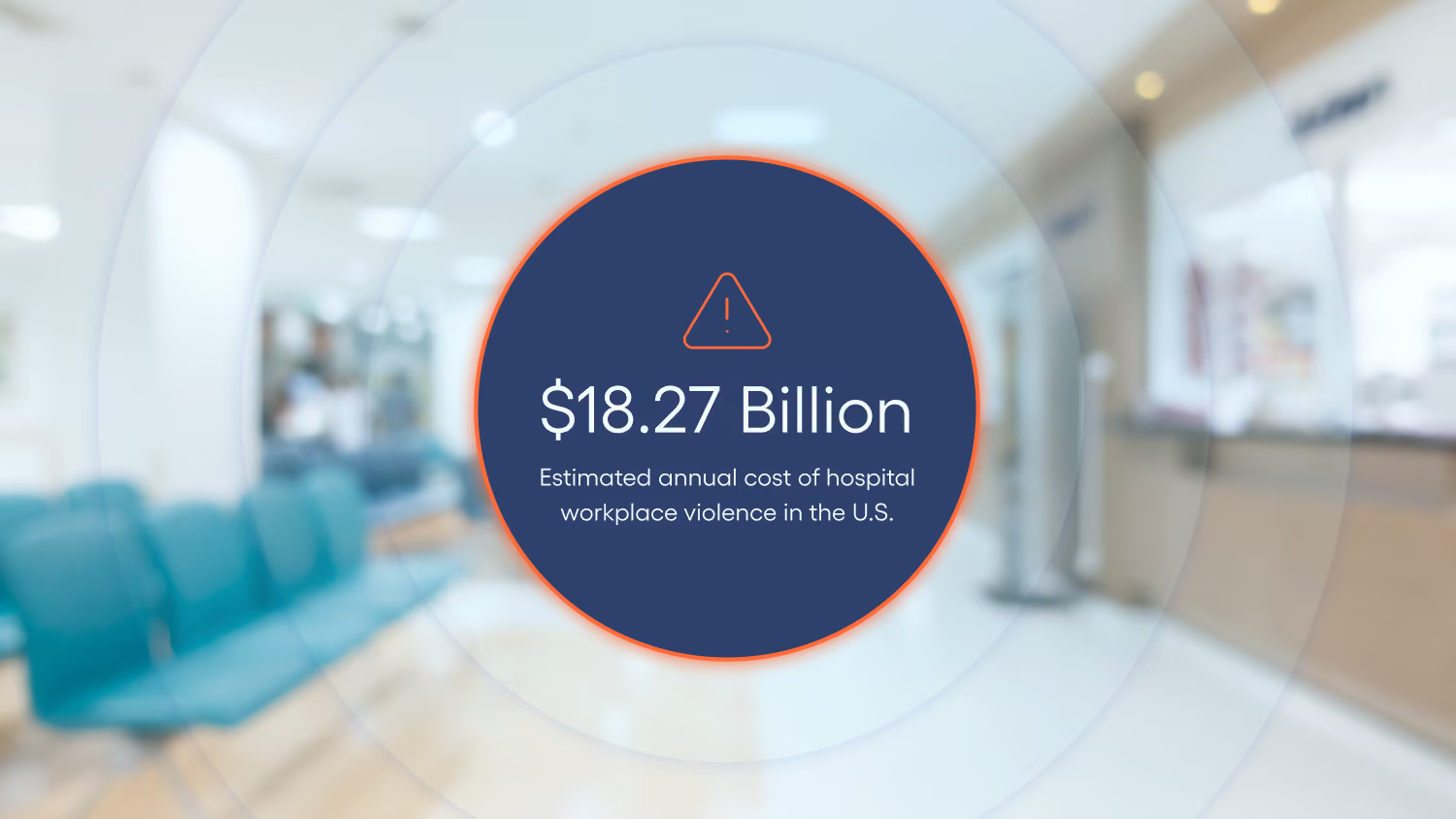
Violent incidents cost U.S. hospitals an estimated $18.27 billion annually. In-facility violence drives an estimated $218 million in turnover costs across the industry each year. But those figures capture only what's visible after the fact. Workers' compensation claims, litigation exposure, and contract labor premiums are the end of a chain that starts much earlier, with situations that go unreported, operational disruptions that never make it into a financial model, and turnover decisions made long before a resignation letter arrives.
Understanding where cost accumulates across the arc of a workplace violence incident is the first step toward interrupting it before the most expensive outcomes materialize.
The Data Gap That Makes Everything Harder to Manage
Before examining what workplace violence costs at each stage of an incident, there is a more fundamental problem worth naming: most of it never gets reported.
According to an American Nurses Association report, as many as 80% of workplace violence incidents in healthcare go unreported. A study published in 2015 found that 88% of nurses did not fully report incidents through official reporting channels.
This is a material financial risk that rarely appears in a budget conversation. The $18.27 billion annual figure is based largely on reported incidents. If the true volume of incidents is significantly higher, as the underreporting data strongly suggests, then organizations are making resourcing and prevention investment decisions based on an incomplete picture of the problem. The gap between what is reported and what is happening on the floor is a cultural issue as well as a data integrity issue with direct budget implications.
How Cost Accumulates Across an Incident
Most incidents of workplace violence follow a predictable arc. What's important to understand from an operational and financial standpoint is that the costs across each stage of this arc are not equal, and neither is the window to intervene.
At the earliest stage of an incident, before anything has even happened, there is usually little more than a feeling that the mood in the room has shifted. When a nurse first feels that shift, there’s an opportunity to intervene and stop an incident before it starts. If an intervention happens at this point, the financial and operational cost to your organization is near zero. There are no workers' compensation claims, no incident reports, and no unit disruptions.
As a situation escalates, that changes quickly. Security resources are diverted. Unit workflow is disrupted. The margin for clinical error narrows exactly when the environment is most demanding. If physical injury occurs, a workers' compensation claim is likely and litigation exposure begins. If that nurse decides to leave, add an average of $64,500 in replacement costs. And if the vacancy is filled with contract labor while a permanent replacement is recruited, the financial picture becomes more complex. While hourly rate comparisons between travel and permanent nurses can vary, contract labor introduces budget volatility. Frequent onboarding of staff unfamiliar with facility protocols creates operational drag. The disruption that comes with frequent staff turnover has documented downstream effects on patient satisfaction and care quality, both of which carry their own financial consequences. For a unit managing multiple vacancies simultaneously, those costs compound in ways that rarely appear as a single line item.
And the costs do not end when the incident does. The physiological load nurses carry from each crisis-stage event compounds over time, contributing to burnout that research consistently links to lower care quality and patient satisfaction. Each incident that goes unaddressed structurally accelerates the burnout and turnover cycle that drives contract labor dependency. By the time turnover data reflects the problem, the cultural erosion has been underway for some time.
The ROI of Intervening Earlier
The difference between a response before an incident has occurred and a response after it has become a crisis is a matter of timing, and whether your staff has a way to ask for help when that window is open.
That is the gap a modern wearable duress system, such as Canopy Protect, is designed to close. When a nurse senses a shift in a patient or family member, they need a way to call for help discreetly, without interrupting care or alerting the patient. The most effective systems do more than notify a central security station. They alert nearby colleagues who can respond in seconds, getting the right people to the right place before a situation escalates. Canopy Protect is purpose-built for this environment, deployed across 70+ health systems and protecting more than 350,000 healthcare workers. It also gives leadership the data they need to understand where incidents are concentrated, track response times, and make the case for continued investment in staff safety.
The financial return is direct. An incident interrupted before it starts does not generate a workers' compensation claim, a formal incident report, or a data point in a regulatory survey. It does not become a factor in a turnover decision. Fewer crisis-stage incidents mean fewer claims, less litigation exposure, less staff time lost to post-event processing, and reduced contract labor dependency. Over time, organizations that intervene earlier see measurable improvements in staff retention, engagement, and satisfaction scores, each of which carries its own financial return.
The Bottom Line
Organizations that invest in early intervention do not just reduce individual incident costs. They reduce the conditions that generate those costs: turnover, contract labor dependency, regulatory exposure, and operational disruption that accumulate when staff don’t have a reliable way to ask for help before a situation deteriorates.
The intervention is early. The cost, in every sense of that word, is lower.
The Physical Impact of Workplace Violence on Nursing Staff
Before a violent incident occurs, there is already a cost. Read about what happens inside a clinician's body at each stage of a workplace violence incident, and why the timing of intervention matters.